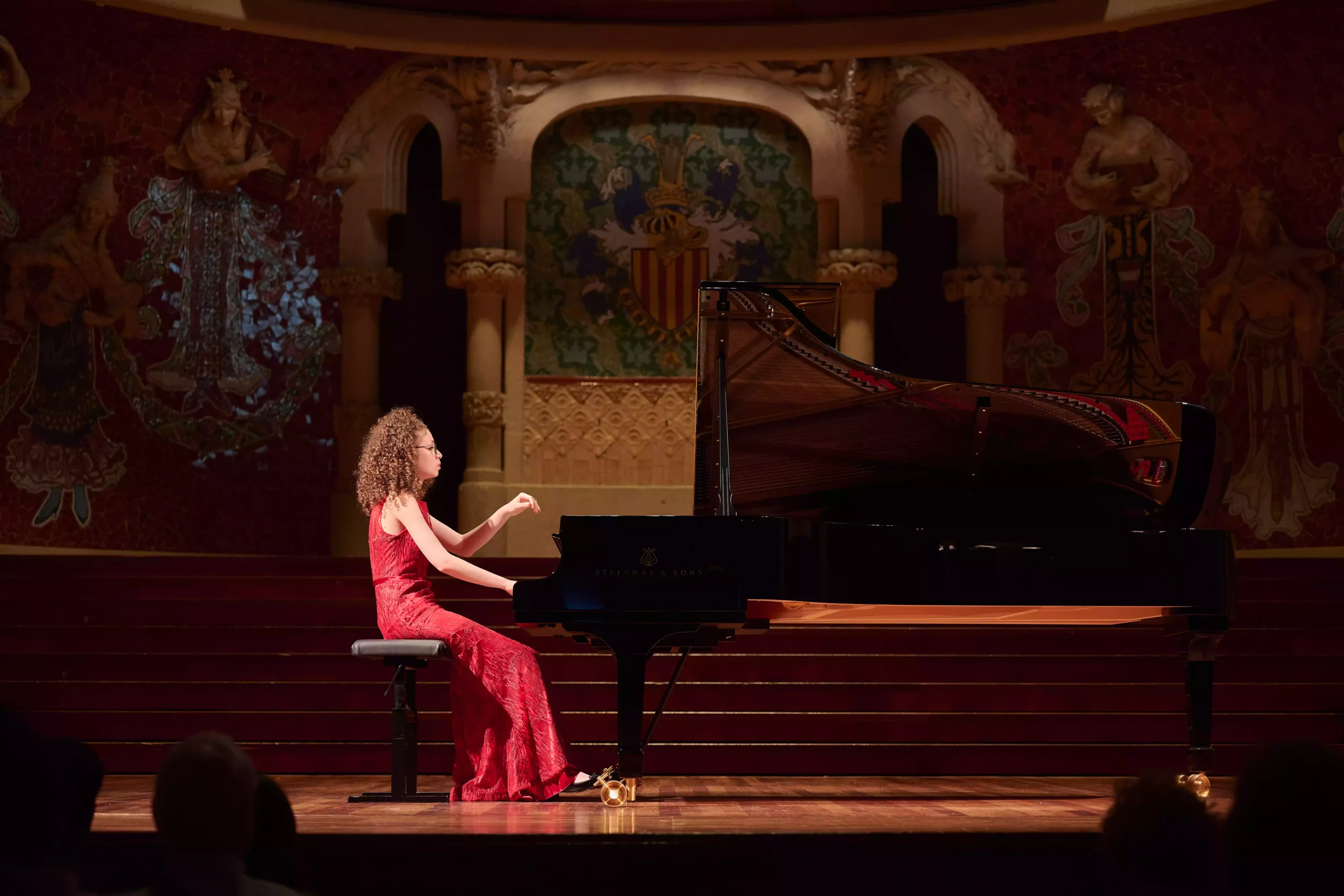
Debut at the Palau de la Musica in Barcelona
Arielle Beck: This is not a child prodigy…
… Magritte might have said! For if we claim to cast an aesthete’s eye on an artist of incommensurable talent, we must completely disregard her young age and listen to her without that bias of “benevolence” so often reserved for young prospects. She is by no means a promise for the future, but a fully-fledged performer. What strikes the listener first is the extreme clarity of her structural organization of the music: her lines of force unfold within an Apollonian, calm, and poised atmosphere—much like the forest of flying buttresses in a Gothic cathedral, hinting at its underlying tensions—while still leaving ample room for incandescent outbursts that inevitably recall the young Martha Argerich (one of her mentors), even though their playing and personalities are fundamentally different. Here and there, she allows herself a few charming touches of mischief (the Scherzo from Beethoven’s “Pastorale” Sonata, Prokofiev’s sonatas), but one is above all struck by the diversity of emotional states and their ideal sonic translation. Listening to her requires a singular focus and attention if one wishes to follow the refined intricacies of her approach to musical discourse in detail.
She pays remarkable attention to the drawing of inner voices: the viola and cello lines sing with a distinct personality, always shaped with care and imagination. This brings to mind Piatigorsky’s quip: when asked to name the best cellist of his time, he replied without hesitation, “Rubinstein!” For the Polish pianist drew that tenor register on the piano with such mastery that one truly believed they heard the suggested instrument… I have not yet had the opportunity to listen to Arielle Beck’s debut album, Des lunes et des feux, where, alongside Schumann’s Humoreske and a composition of her own, she presents the entirety of Brahms’s Opus 76, that sovereign composer of inner-voice counter-melodies; I imagine it is a true delight. Furthermore, I am certain that her work as a composer deserves to be followed with the greatest interest.
André Gide wrote in The Fruits of the Earth (Les Nourritures terrestres): “Let the importance be in your look, not in the thing looked at.” Unquestionably, it is Arielle Beck’s look at the composers that challenges us first, even if the dexterity she displays on the keyboard seems diabolical or, quite simply, superhuman! Witness the paroxysm of octaves she unleashes in Mendelssohn’s Rondo capriccioso or in the finale of Beethoven’s “Pastorale”. Or the satanic passages in the Scherzo of Chopin’s Sonata in B minor, from which she transitions without pause to the contained anguish of an ethereal Largo that moves one to tears (Chopin composed this sonata in Nohant during the summer of 1844, grieved by the death of his father, Nicolas). A somber picture too is Prokofiev’s Fourth Sonata, completed in 1917 on the eve of the October Revolution. The composer was then haunted both by the horrors of the First World War and by the memory of the suicide of his close friend Max Schmidthof, to whose memory the work is dedicated. Arielle Beck delicately absorbs the melancholy of the beginning of the last century to bewitch us with strange sonorities, where virtuoso brilliance fades in favor of emotion and clarity of discourse.
What a joy, also, to hear this pearly playing, extremely light and precise, in the purest French tradition, which Cortot would have adored! She shares with him a light-hearted elegance, a sense of the moment (and undoubtedly a literary culture as well), but without missing a single note in circussian flights that will make generations of pianists pale with envy!
Not content with having offered us an hour and a half of music without respite, she responded to the audience’s calls by tackling Prokofiev’s Third Sonata—a single movement, Allegro tempestoso: a dizzying surge of fiery chords in a devilish tempo! And to crown the evening with serenity, she offered Chopin’s Berceuse, a small nod to invite the audience to rest…
Amidst the convulsions of our world, the future of the art of interpretation looks very bright indeed. Artists like Arielle Beck or María Dueñas, the latest to be heard at the Palau, will leave a lasting imprint. Honor to this glorious youth!
Xavier Rivera
Barcelona, Palau de la Música Catalana, September 30, 2026
Photo credits: Mario Wurzburger